 The Question Underneath: Why “Just Forgive Yourself” Never Worked
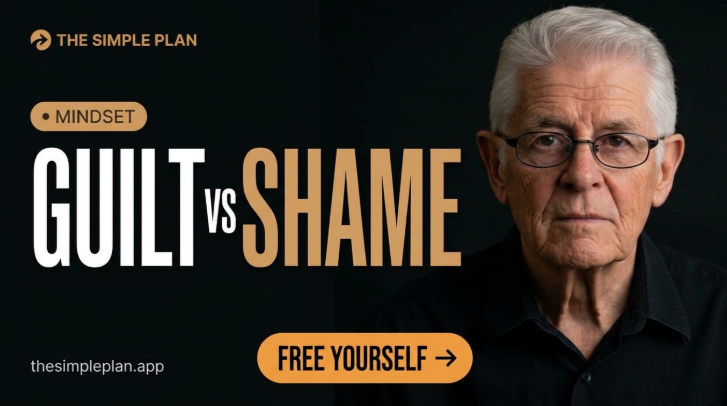
Guilt says, “I did something wrong”. Shame says, “I am something wrong”.
Those two need completely different answers.”
By Glen Kerby | The Simple Plan, Based on the Work of Ken M.
How Long Have You Been Carrying It?
For some of us, the honest answer is months. For many of us, it’s years - and we can point directly to the exact season it all started. We’ve heard “you have to forgive yourself” from caring people who meant every word of it. We nodded gently, walked out of the room, and realized we were still carrying the exact same heavy weight we walked in with.
If you’ve experienced that, I want to share something reassuring: this is not a willingness problem. We obviously want to let go of the things of the past that are trying to steal our joy. One day at a time gets used as an idea about not borrowing trouble from tomorrow, but it is also a powerful reminder about not holding onto yesterday.
If self-forgiveness were a single, simple decision, you would have made it already. You aren’t still carrying this because you haven’t tried hard enough. You’re carrying it because the standard way most of us are taught to approach self-forgiveness doesn’t match what’s actually happening inside our hearts.
Two Different Things Wearing the Same Coat
Ken M., who wrote The Simple Plan, draws a clear distinction that completely reshaped how I view this struggle: Guilt and shame are not the same thing, and they require completely different solutions.
1. Guilt is Information
Guilt says: “Something I did caused harm, and that matters to me.” That isn’t the enemy - that’s a healthy, working conscience. When we process guilt honestly, it leads somewhere meaningful. It moves us toward acknowledgment, sincere repair where possible, and a true change of direction. Anyone who has walked through Steps Four, Five, and Nine knows the quiet freedom of letting guilt guide us to a better place. The joy that there is in that first moment we realize we did something wrong and we correct it in that very moment is life changing. We are not just stuffing it somewhere, running and hoping we got away with it anymore.
2. Shame is an Identity Claim
Shame whispers something entirely different: “This isn’t just something I did - this is who I am.”
Shame isn’t information; it’s a heavy verdict about your core worth.
Here is why this distinction matters so deeply: You cannot repair or achieve your way out of shame. Decades of sobriety time won’t erase it. A successful career won’t fix it. Being the most dependable person in every room won’t overturn it. None of those accomplishments address the core claim shame is making. Shame doesn’t say you made a mistake - it says you are a mistake. Doing good things cannot overturn that sentence on its own.
That is why so many of us can put together real time, real change, real amends, and still lie awake with the same sentence running.
The reason so many of us still lie awake at night despite real growth and real amends is simple: We’ve been fighting shame using tools that were only ever designed for guilt.
What Forgiveness Actually Does
Let’s gently unpack what self-forgiveness is not, because misconceptions often keep us from taking the first step:
- It is not deciding that what happened was acceptable.
- It is not minimizing the impact on those who were hurt.
- It is not always a magic moment where the weight lifts forever in an instant.
I have however seen moments in my life and in the lives of people in the program, where the prayer, the moment of decision created a release that was a life changing moment. So don’t worry about the journey to freedom as much as the destination, what matters is that we are applying the tools of a new life to gain greater freedom.
What happened is real, and it carries consequences. Forgiveness does not erase history. What genuine forgiveness does is release you from defining your entire identity by those past consequences. It does battle with the idea that we are permanently damaged by the past.
What forgiveness does is release us from holding the full weight of those consequences as evidence of what we permanently are.
You are not only what happened in the worst season. You are also what came before it. You are what has happened since. You are what you are doing right now, in this minute, by being willing to read something like this instead of turning away from it again.
The Move, One Step at a Time
The Simple Plan teaches this as a move from left to right. On the left side is the thing where it hurts. On the right side is the same thing, honestly understood. The bridge across is always the same: willingness, honesty, humility, and the next right thing.
For self forgiveness, that walk has four moves.
Name it honestly. Not to punish yourself again, and there is a real difference. Rehearsing it is not the same as seeing it. Name what actually happened and what the actual impact was. Most of us have either minimized it or catastrophized it, and neither one is the truth.
Separate what you did from what you are. This is the move shame does not want you to make. It is not excusing the action. It is refusing to let the action write the whole story of who you are.
Where repair is possible, in the progression of your steps move toward it. Not to earn forgiveness. Forgiveness is not earned, and if you try to buy it with amends you will make the amends about yourself, which the people receiving them can feel. Repair is honest acknowledgment made visible. That is all, and that is enough. We do this at the right time and in the strength working each step gives us. It is happening at a moment when we are gaining a great understanding of our Higher Power and our new freedom over the past.
Let it become evidence of what you are learning, not proof of what you are. You may share something with someone else that is a direct result of a past mistake or experience, and in that moment you see the conversion of something that was horrible and wrong transforming into a testimony of a new life.
That last part matters in here more than anywhere. Shame is the thing that grows in private. It has to be said out loud, in front of someone who does not flinch, before it starts to lose its grip. That is not a new idea to anybody who has worked a Fifth Step. It is the oldest idea we have. Secrets keep us sick, and honesty begins setting us free. We are admitting something to ourselves, to our Higher Power and to another trusted person and we feel the weight lift off of us in a profound way.
It all happens in real community so remember sponsorship, meetings, working the Steps.
Is the Power I Turned To Big Enough for This?
There is a question sitting underneath all four of those moves, and it is not really a question about the past. It is a question about who we turned our will and our lives over to.
Do I have a Higher Power that is actually capable of doing what the Steps are asking it to do?
That is not a doubt to be ashamed of, it is like assessing a skill or a tool in our hands for a job that needs to be done. It is a fair question, and most of us have to answer it more than once. We say the words in Step Three and we mean them on the day we say them. Then we come up against the thing we cannot go back and change, and we find out what we actually believe.
Because the Steps are asking for something specific. They are asking a Power greater than ourselves to restore us. To remove what we have never been able to remove on our own. To do the part of this work that no amount of effort has ever touched.
Is my Higher Power capable of that?
Does that Power love me? Not people in general. Me.
Have I actually given that Power my confidence, or have I given it my words and quietly kept the weight?
That last one is where I get caught. I can turn something over in a prayer and take it back before I finish the sentence.
Here is where I have landed: if there is a Power greater than me, and that Power sees me, sees my heart, not the version I present but the actual one, and wants me free of the things I cannot go back and change, or transform those moments into testimonies of freedom, then there is only one question left, and it is mine to answer.
Will I let go, and let that Power do the work?
Letting go is not passive. It is the most active thing we do in here. We still name it honestly. We still separate what we did from what we are. We still make repair where repair is possible. But the lifting of the weight, the thing we have been trying to accomplish by being good enough for long enough, that part was never ours to do.
I can’t.
You can.
I’ll let You.
Some of us are not sure yet what we believe about any of that. That is allowed in here. Willingness comes before certainty, and it always has. You do not have to be sure that Power loves you. You only have to be willing to stop carrying alone what it has been offering to carry.
Ken’s Answer, In His Words
Ken has been answering these questions, the ones people type into a search bar alone at night and would not say out loud in a room, and we have been putting them on YouTube where they can be found by the person looking. If you are feeling these things and you have access to other people in recovery, to forums, to meetings, share what is going on in your life, it can change someone else’s life in the process. You may also encounter someone who has walked the same path and can be a special person in your new life. We break the back of loneliness by finding people that understand the road we are on, because they have been on the same road. In that moment we begin to realize that we are less alone than we thought.
There is one on this exact question, and it is worth five minutes so I have gathered together some support from Ken’s teaching on forgiveness and related topics to a new life:
How Do I Forgive Myself? Guilt, shame, and the actual process, not the concept.
A few others from the same series that people in the rooms keep coming back to:
Why Am I Always Tired? The exhaustion that sleep does not fix.
Why Do I Feel Stuck? For the stretch where nothing is technically wrong and nothing is moving either.
And if you want to know who Ken is and why his teaching now reaches people the way it does, start here: What Now, When Life Hits You Hard The story behind the avatar, and the moment in Ken’s life that he refused to let define him.
Ken faced something that could have written the rest of his story for him, and he decided it would not get to. Everything else he teaches comes out of that decision to not let a diagnosis steal his voice. He wanted to keep sharing his experience, strength and hope, and with your help, he is still reaching hundreds of thousands of people with a simple message that points to a new life. Thank you for sharing any of these messages that touch you in a meaningful way.
You are not alone in here.
The Simple Plan is free. The book, the daily practice, and the full library of Ken’s answers. No cost, no catch, no shame.
Glen Kerby is a producer and author, and the founder of The Simple Plan, a free recovery platform built on the work of author Ken M. He writes about recovery, healing, and the practical work of putting weight down.